This is a presentation of Sanatan philosophical and scriptural narrative as described in traditional texts. It is offered as spiritual heritage and inspiration — not as a scientific claim, and not as proof that modern multiverse theories validate it.
Sound off
The Cosmological Sequence
From the infinite. Into existence.
The sequence follows the supplied Anant Koti Brahmand narrative, primarily its Vaishnava cosmological framework. Shaiva, Shakta and Advaita traditions offer distinct interpretations; this is not a universal ranking of traditions. Quotations and references are reproduced from the owner's source; meanings are interpretive translations, not independent textual verification.
01 / 10
परब्रह्म
PARABRAHM
The supreme, infinite reality
Endless, formless truth — everything exists within it. 'Parabrahm' means 'that beyond which there is nothing higher'. Universes, the multiverse, devtas, time and space are all within Parabrahm, not above it — just as no wave rises above the ocean; every wave is within it.
Traditions name the Supreme differently: Vaishnava — Shri Krishna; Shaiva — Parashiv; Shakta — Adi Parashakti; Advaita — Nirguna Brahman. Each is respected here.
02 / 10
परव्योम
PARAVYOM
The spiritual sky and eternal abodes
Vaikuntha, Goloka, Kailash and Manidweep — eternal abodes that are never destroyed. The source describes this as three-quarters of the Lord's vibhuti (opulence).
Superior even to Kailash, Vaikuntha and Goloka — the Devi's Manidweep is 'Sarvaloka', above all universes.
03 / 10
विरजा · कारण सागर
VIRAJA / KARAN SAGAR
The boundary between realms
The Viraja river, or Causal Ocean, is the boundary line between the spiritual and material worlds. On one side is Maya; on the other, Maya has no entry.
04 / 10
महाविष्णु (कारणोदकशायी)
MAHA VISHNU — KARANODAKSHAYI
First Purusha Avatar · the cosmic breath
Maha Vishnu rests in yoga-nidra in the Causal Ocean. As He breathes out, innumerable universes emerge from the pores of His body like bubbles; as He breathes in, all return. One such breath equals the full lifespan of a Brahma — 311.04 trillion years by the source's calculation.
The lords of the universes that emerge from Maha Vishnu's pores live only for the duration of one of His breaths. I worship Govinda, the original Person, of whom that Maha Vishnu is a portion.
05 / 10
अनंत कोटि ब्रह्माण्ड
ANANT KOTI BRAHMAND
Innumerable universes
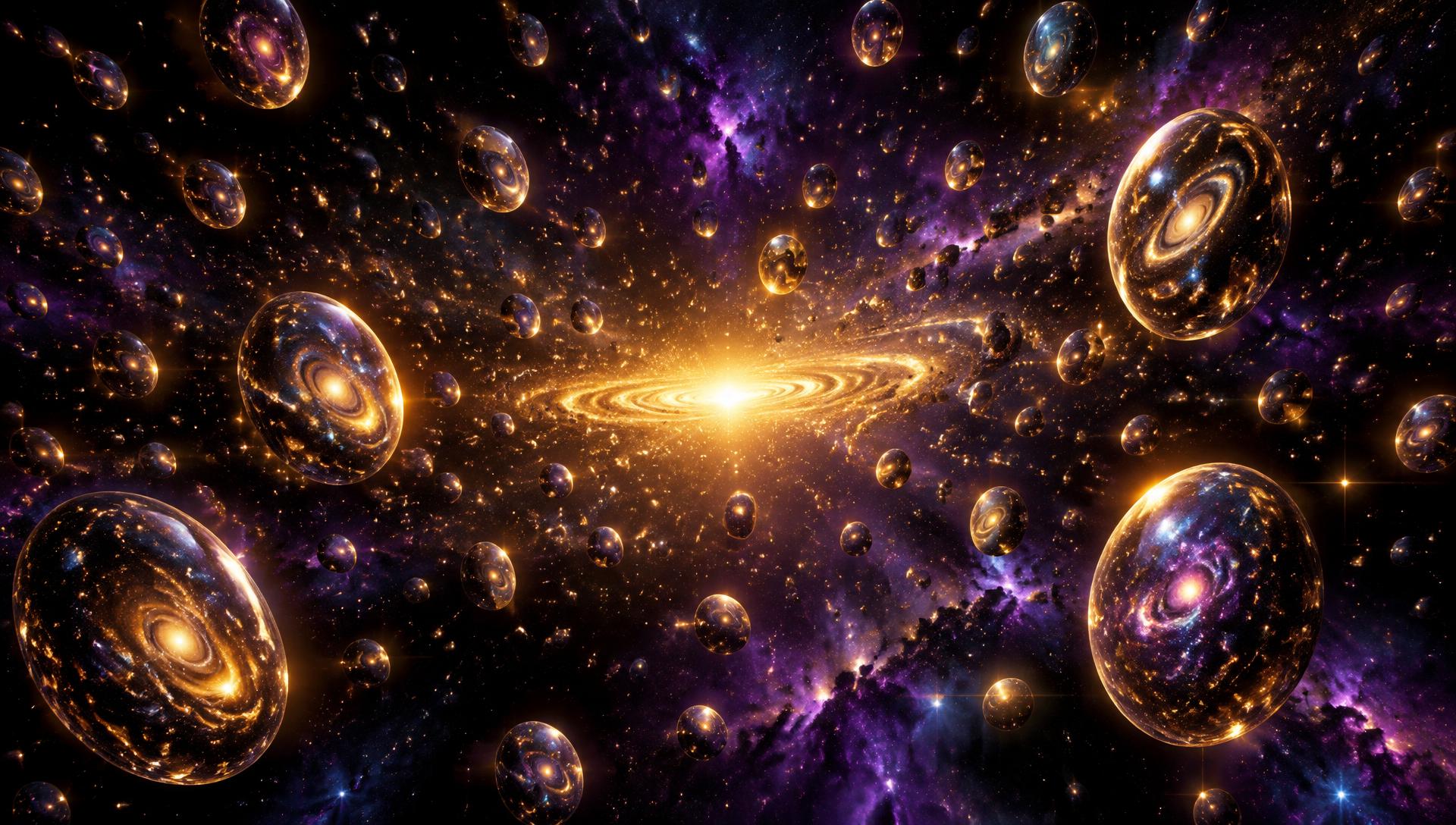
Countless egg-shaped universes emerge from Maha Vishnu's pores — like specks of dust drifting through a window lattice. Brahmand means 'Brahma's egg'; Anant Koti means 'crores upon crores, without end'.
Important: the universes are not avatars. They are creation (rachna), made from the Lord's energy (Prakriti). The One who creates them — Maha Vishnu — is the avatar. Creator and creation are distinct.
This universe is covered by seven layers, each ten times the previous; crores upon crores of such universes move within You like atoms — therefore You are 'Anant'.
06 / 10
गर्भोदकशायी विष्णु
GARBHODAKSHAYI VISHNU
Second Purusha Avatar · within each universe
He enters every single universe, fills half of it with the Garbha waters and reclines on Shesha. From His navel grows a lotus; on the lotus appears Brahma. Within the lotus stem lie the fourteen lokas.
✧ब्रह्मा · नाभि कमल
07 / 10
ब्रह्मा
BRAHMA
Creation · Rajo-guna
Born on the navel lotus, Brahma meditates upon the Lord and then creates the rest of the universe, including the fourteen lokas. Every universe has its own separate Brahma.
08 / 10
क्षीरोदकशायी विष्णु
KSHIRODAKSHAYI VISHNU
Third Purusha Avatar · preservation · Sattva
Residing in Shwetadweep in the Kshira Sagar within our universe, He is the 'Vishnu' of the Trimurti. He preserves, and as Paramatma (Antaryami) dwells in the heart of every being and every atom. The Dashavatar descend from Him, and the devtas approach Him in times of crisis.
Vishnu has three Purusha forms: the first creates the Mahat (total material elements), the second resides within each universe, the third resides in all beings. One who knows them is liberated.
09 / 10
रुद्र
RUDRA
Dissolution · Tamo-guna
In the source, Brahma (Rajas), Vishnu (Sattva) and Rudra (Tamas) are the Guna Avatars — one set in every universe — who govern creation, preservation and dissolution. Rudra/Shiva holds the place of dissolution in the cosmic cycle; the source stresses that pralaya is rest and renewal, not an end.
10 / 10
चौदह लोक
THE FOURTEEN LOKAS
Seven above, seven below
Every universe contains fourteen lokas — seven upper (Bhu to Satya) and seven lower (Atal to Patal). They repeat in every universe: infinite universes mean infinite Satyalokas, infinite Swargas, infinite Earths.
Brahma and Saraswati; near to liberation — no rebirth from here.
According to Bhagavatam (5.24), the Patal lokas are not hells — they are described as having pleasures, gems and palaces exceeding even Swarg. Naraka is a separate region. Bhu, Bhuvar and Swar are the three vyahritis of the Gayatri (भूर्भुवः स्वः).
सप्त आवरण
The Seven Avaran
ब्रह्माण्ड
Prithvi (Earth)
Gandha — smell
Each universe is egg-shaped; its hollow interior holds the fourteen lokas, Sun, Moon, planets and stars. Outside are seven coverings, each ten times thicker than the previous (Bhagavatam 3.11.41). Beyond the outermost lies Pradhan/Prakriti, then the Causal Ocean. The order of layers differs slightly between verses; the source follows Bhagavatam 6.16.37.
Dashavatar
The Ten Divine Avatars
Different Sanatan traditions present different Dashavatar lists — some include the Buddha, others Balarama. This presentation respectfully follows the Brand Bible's chosen sequence, which includes Balarama.
Symbolic devotional artwork
मत्स्य
Matsya
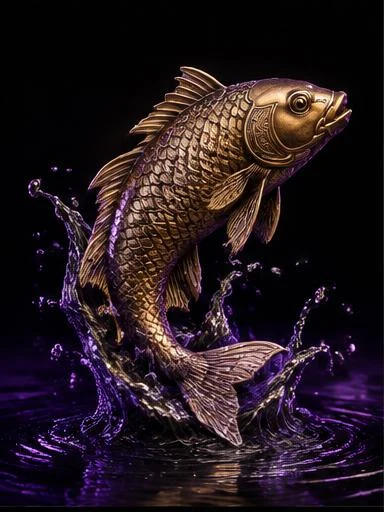
Protected creation from the waters of pralaya.
Matsya Avatar — Knowledge and Protection
Matsya represents the preservation of knowledge and the protection of life's essential foundations. The lesson is that even in times of great uncertainty, wisdom and truth must be protected for the future of humanity.
Where are we now, according to tradition: the 51st year of Brahma (second Parardha), Shweta Varaha Kalpa, the 7th (Vaivasvata) Manvantara, the 28th Chaturyuga, Kali Yuga — traditionally begun in 3102 BCE.
Satya Yuga
Dharma on four feet
17,28,000 human years
Treta Yuga
Dharma on three feet (Rama)
12,96,000 human years
Dwapara Yuga
Dharma on two feet (Krishna)
8,64,000 human years
Kali Yuga
Dharma on one foot
4,32,000 human years
1 Chaturyuga
All four yugas together
43,20,000 human years
1 Manvantara
71 Chaturyugas — one Manu, one Indra, one Saptarishi circle
30,67,20,000 human years
1 Kalpa
1,000 Chaturyugas = one day of Brahma
4.32 billion human years
1 Year of Brahma
360 days and nights
3.11 trillion human years
Maha-Kalpa
100 years of Brahma = one breath of Maha Vishnu
311.04 trillion human years
Pralaya
Dissolution. Rest. Renewal.
Nitya Pralaya
Every moment
The continual birth and death of beings, the changing of bodies — happening every day.
Per Vishnu Purana (1.7) and Bhagavatam (12.4). The source notes: pralaya is not an end — it is rest.
Our Corporate Vision
From Eternal Values to Meaningful Development
SARVOTTAM PARBRAHMA REAL ESTATE INDUSTRY Pvt. Ltd.
Anant Koti Brahmand is a source of spiritual inspiration and symbolic brand storytelling. It is not a literal corporate organisational chart or a scientific claim. The company is a proposed real estate and infrastructure enterprise, not a divine entity, avatar or religious institution.
सृष्टि
CREATION
Creating meaningful places, homes, and opportunities.
स्थिति
PRESERVATION
Quality, transparency, responsibility, and long-term stewardship.
सेवा
SERVICE
Respect for customers, communities, families, and future generations.